Tag Archives: Mount Vernon Criminal Defense

Driving With Wheels Off the Roadway

In State v. Brooks, the WA Court of Appeals held that the neutral area separating a highway on-ramp from an adjacent lane of travel does not meet the definition of “roadway.” A driver who crosses this area is properly stopped for a violation of Driving with Wheels Off Roadway under RCW 46.61.670.

BACKGROUND FACTS

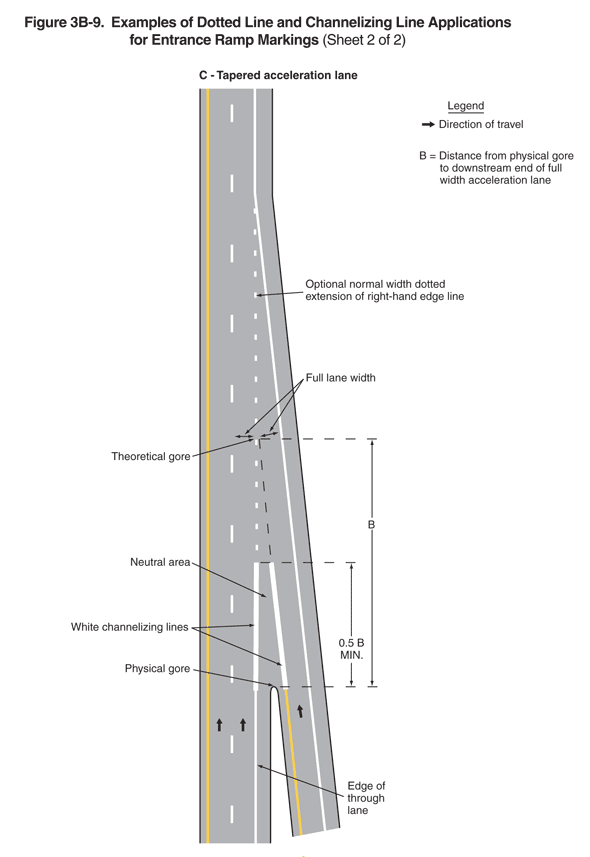
While merging onto westbound U.S. Route 97 from U.S. Route 2 in Chelan County, Jena Brooks’s car crossed over a portion of the highway designated as a “neutral area.” A neutral area is a paved triangular space separating an entrance or exit ramp from an adjacent lane of highway. The neutral area between Route 97 and its merger with westbound Route 2 is marked on each side by thick white channelizing lines. The drawing below is a depiction of a neutral area similar to the one crossed by Ms. Brooks:

Image result for ON RAMP NEUTRAL AREA

A Washington State Patrol trooper observed Ms. Brooks’s vehicular activity and performed a traffic stop. Ms. Brooks was ultimately arrested for driving on a suspended license and other misdemeanor offenses.

During proceedings in district court, Ms. Brooks filed a motion to suppress, arguing her vehicle had been stopped without probable cause. The motion was denied. Pertinent to this appeal, the district court ruled Ms. Brooks’s merger over the highway’s neutral area constituted “driving with wheels off roadway,” in violation of RCW 46.61.670. 2

Ms. Brooks was subsequently convicted of several misdemeanor offenses after a jury trial. Later, she successfully appealed the suppression ruling to the superior court. It found Washington’s definition of a roadway ambiguous in the context of a highway’s neutral area. The superior court then invoked the rule of lenity and determined Ms. Brooks should not have been stopped for driving with wheels off the roadway in violation of RCW 46.61.670.

ISSUES

The Court of Appeals addressed (1) whether the term roadway is ambiguous in the current context, and (2) if the term is ambiguous, whether the rule of lenity is an available tool of statutory construction that might benefit a defendant such as Ms. Brooks.

ANALYSIS & CONCLUSIONS

“A highway’s neutral area is not a vehicle lane. It is too short to facilitate meaningful travel. And its triangular shape cannot consistently accommodate the size of a vehicle. Rather than being designed for vehicular travel, it is apparent the neutral area is designed as a buffer zone. It keeps vehicles separate so as to facilitate speed adjustment and, in the context of a highway on-ramp, safe vehicle merging.”

The Court further reasoned that National standards set by the Manual on Uniform Traffic Control Devices for Streets and Highways (MUTCD) confirmed its observations about the apparent design purpose of a highway’s neutral area. In short, the Court reasoned the MUTCD refers to the neutral area as an “island.” As such, it is an area intended for vehicle “separation.”

“Although a neutral area may be designated either by a wide or double solid white channelizing line, the two options carry no substantive significance” said the Court of Appeals. “Like a double white line, a solid white line can serve as an indicator that crossing is prohibited. The whole point of a neutral area is to exclude vehicles and promote orderly and efficient traffic flow,” said the Court of Appeals.

The Court concluded that Ms. Brooks failed to maintain her vehicle wheels on an area of the highway meeting the statutory definition of a roadway. A vehicle stop was therefore permitted under Washington’s wheels off roadway statute. Consequently, the superior court’s order on appeal from the district court is reversed.

Surprisingly, there’s quite a bit of caselaw on what constitutes “Driving With Wheels Off the Roadway.” Please contact my office if you, a friend or family member face criminal charges following after a police officer pullover where this citation led to arrest. It’s quite possible to suppress the fruits of a search based on unlawful stop, search and/or seizure.

DWLS-III Decriminalized?

Excellent article by Seattle Times staff reporter discusses how a birpartisan group of lawmakers is continuing to push for change in a law that legislators, civil-rights groups and others say disproportionately burdens the poor and communities of color.

Senate Bill 6189, which is sponsored by Sen. Joe Fain, R-Auburn, would decriminalize the charge of third-degree driving with a suspended license (DWLS-III), a misdemeanor. Under current state law, those caught driving with a suspended license due to unpaid traffic tickets or because they didn’t show up for court hearings can be jailed.

The bill has been referred to the Senate’s Law and Justice Committee but not yet scheduled for a hearing. Sen. Jamie Pederson, D-Seattle, who chairs the committee, said he agreed the issue is important, but with a short legislative session and many bills to review, he was hesitant to say if he will schedule a hearing on a proposal that in the past hasn’t been successful.

According to a 2017 report by the American Civil Liberties Union of Washington, Driving While License Suspended Third Degree is the state’s most commonly charged crime. SB 6189 would remove its misdemeanor status and make the charge a traffic infraction with a $250 penalty. The penalty would be reduced to $50 if a defendant could show he or she got the license reinstated.

 Pacheco reports that since 1994, prosecutors in Washington state have filed some 1.4 million charges and obtained 860,000 convictions, according to the ACLU report. Native Americans were twice as likely as whites to be charged with the crime of third-degree driving while license suspended (DWLS-III), and blacks were three times as likely.

According to Pacheco, unpaid traffic infractions can pile up quickly, with some people accumulating thousands of dollars in fines that must be paid off to reinstate their license, said Rick Eichstaedt, executive director of the Center for Justice, which operates a program in Spokane that helps people reinstate a suspended license.

The Washington Association of Sheriffs and Police Chiefs has opposed previous efforts to decriminalize DWLS-III, but Executive Director Steve Strachan said the organization recognizes the financial burden the law has caused. The association wants to work with legislators to find a balanced solution to DWLS-III where accountability still exists and abuse of the system is discouraged, Strachan said.

Fain, the Auburn lawmaker, previously worked in the King County Prosecuting Attorney’s Office and said he witnessed a deluge of DWLS-III cases that made it difficult to focus on more important cases, such as drunken driving.

In 2009, in conjunction with King County District Court, the prosecutor’s office stopped charging stand-alone DWLS-III cases, but Fain said prosecutors still spent a lot of time handling such cases tied to other crimes.

“I want to spend more of my time on things that will actually improve public safety,” Fain said. “I think individuals, especially lower-income people, living paycheck to paycheck need to be able to go to work and pay their fines,” Fain said, “so you want to make sure you’re not inhibiting a person’s ability to comply with the law.”

Pacheco correctly states that DWLS-III charges are the least serious of the DWLS charges. First- and second-degree driving with a suspended license are charges aimed at habitual offenders and those who lost their licenses due to drunken-driving or reckless-driving convictions.

Co-sponsor Sen. David Frockt, D-Seattle, said fines and the possibility of jail time under the current law effectively criminalize poverty and hurt communities of color.

“Putting people into this cycle where people get fined and they can’t pay and get further fined,” said Frockt, “there’s other alternatives.”

Pacheco says that if a measure is passed, Washington would join a handful of states that have decriminalized driving with a suspended license, including Oregon, Wisconsin and Maine, according to the National Conference of State Legislatures.

In 1993, Senate Bill 1741 made driving with a suspended license due to unpaid traffic infractions a misdemeanor.

My opinion? I hope the legislature decriminalizes DWLS-III. These charges essentially hook people into the criminal justice system for failing to pay traffic fines.  The charges also expose people to a search incident to arrest with the very real possibility of police finding illegal contraband which may lead to heavier charges. Also, a DWLS-III conviction makes it difficult for people to get to work and further holds back those working their way toward paying off fines and avoiding more fines or jail time.  Please contact my office if you, a friend or family member is charged with DWLS III.

Witness Tampering

In State v. Gonzalez, the WA Court of Appeals decided there was sufficient evidence that the defendant attempted to influence a witness to testify falsely where he asked the witness to give a different story than the one she told the police.

BACKGROUND FACTS

The defendant Leonel Gonzalez was in a relationship with Nona Hook for several years. Hook lived with her mother, Carol Salyers, and several other family members, and Gonzalez was frequently in the home. Salyers owned a Jeep and permitted Hook, but not Gonzalez, to drive it.

In the early morning hours of September 21, Gonzalez called Hook, and she asked him if
he had taken her Jeep. According to Hook, Gonzalez denied knowing anything about the Jeep, but he told her that he was “coming home.” At some point after this call, someone contacted the police.

The police were waiting when Gonzalez arrived at Hook’s home in the Jeep. Upon seeing
the police, Gonzalez drove away, jumped out of the Jeep while it was still moving, and attempted to flee on foot. The Jeep rolled into and damaged a parked vehicle. The police caught and arrested Gonzalez. Following his arrest, officers discovered a white substance that later tested positive for both methamphetamine and cocaine in Gonzalez’s back pocket.

Jail Call

While in jail following his arrest, Gonzalez called Hook. This call was recorded.

During the call, Gonzalez insisted that Hook listen to him and told her that some people
were trying to contact her and that when his “investigator” or “somebody” called her, she was to tell them that she “gave him permission.” Hook responded, “Tell them that I gave you permission,” and Gonzalez interrupted her and told her to “listen” and said adamantly, “That’s it.”

Hook responded by chuckling and saying, “That’s gonna be a little bit hard for me to do.”  Gonzalez appears to respond, “Well, then don’t do it.” The rest of Gonzalez’s response is unclear.

Hook replied, “I mean, for one thing, I was—you already know what the deal was.” And Gonzalez told her aggressively to “listen” and that they were not “going to talk about all that.” He then stated, “You know what to do, so.” Gonzalez and Hook then talked about when Hook could visit so they could talk about their relationship and whether they would marry even if he was in prison. During this part of the conversation, Hook commented about how hard it was for her to be away from him, and Gonzalez responded by asking her whether she “would rather deal with” 6 or 15 years.

Criminal Charges

The State charged Gonzalez with theft of a motor vehicle, unlawful possession of a controlled substance (methamphetamine), hit and run, and tampering with a witness.

Jury Trial & Appeal

At trial, Ms. Hook testified about the jail calls. Ultimately, the jury found Gonzalez guilty of unlawful possession of a controlled substance and tampering with a witness.

Gonzalez appealed under arguments that the evidence was insufficient to support the witness tampering conviction because (1) he asked Hook to speak to his investigator and never discussed her testimony and (2) there was no evidence he was asking Hook to testify falsely.

COURT’S ANALYSIS & CONCLUSIONS

Gonzalez argues that the State failed to prove that he was attempting to influence Hook to
testify falsely because he asked her to tell the defense investigator only something different than she told the police. He asserts that speaking to the defense investigator is not the equivalent of testimony.

“We disagree,” said the Court of Appeals. The Court reasoned that Gonzalez’s request that Hook tell the defense investigator a different story than she told the police would have little effect if it did not also imply that Hook needed to also be willing to testify consistently with what she told the defense investigator. “Thus, a rational finder of fact could have easily found that Gonzalez was attempting to influence Hook’s potential testimony,” said the Court.

Gonzalez also argued that there was insufficient evidence to establish that he asked Hook
to testify falsely.

“Again, we disagree,” said the Court of Appeals. “At no point in her testimony did Hook testify that she had given Gonzalez permission to take the Jeep on September 18th,” said the Court. Instead, she testified that she dropped Gonzalez off, drove the Jeep home and parked it, and left the keys near the back door. Although Gonzalez came into her bedroom the next morning, Hook did not testify that he asked for or that she gave him permission to drive the Jeep.

The Court of Appeals further reasoned that taking this evidence in the light most favorable to the State, the jury could find that Hook’s testimony established that Gonzalez took the Jeep without her permission and that Hook’s testimony was truthful.

“Given that Gonzalez asked Hook to state that she had given him permission, a rational finder of fact could have easily found that Gonzalez was asking Hook to testify falsely. Accordingly, Gonzalez’s insufficient evidence arguments fail, and we affirm his witness tampering conviction.”

In sum, the Court of Appeals affirmed Gonzalez’s convictions, but remanded for re-sentencing on the unlawful possession of a controlled substance conviction consistent with this opinion.

Please contact my office if you, a friend or family member are charged with a crime. Hiring an effective and competent defense attorney is the first and best step toward justice.